
139 calculators · 9 categories · 3,007 tests · Hebrew
139 calculators in Hebrew:a corpus with a calculation engine, a site map and tests
The trouble with an online calculator
An online calculator looks simple: a field, a button, a result. But behind a gross-to-net salary calculator sit tax brackets, tax credit points, National Insurance and health tax, and each of them changes from year to year. A calculator that doesn't say what it calculates by and what date it's correct for is a guess with a nice design.
A calculator site is also an SEO problem. Dozens and dozens of similar pages need a structure Google understands, internal links that leave no page orphaned, and content that answers the question people actually ask.

What's in the corpus
At GPR I built a complete corpus for a new calculator site, meaning the full body of calculators, pages and data behind it: 139 calculators in Hebrew and a site map of 163 pages. It was built in six days with a team of AI models. A strong model plans and checks, a cheaper model writes to a tight specification, and every stage leaves a document behind.
Silo architecture
Nine categories, from finance and health to conversions and home and kitchen, and 14 sub-hubs. One fixed depth of home, category, sub-hub and calculator, and no deeper. A category with more than 15 calculators splits into sub-hubs.
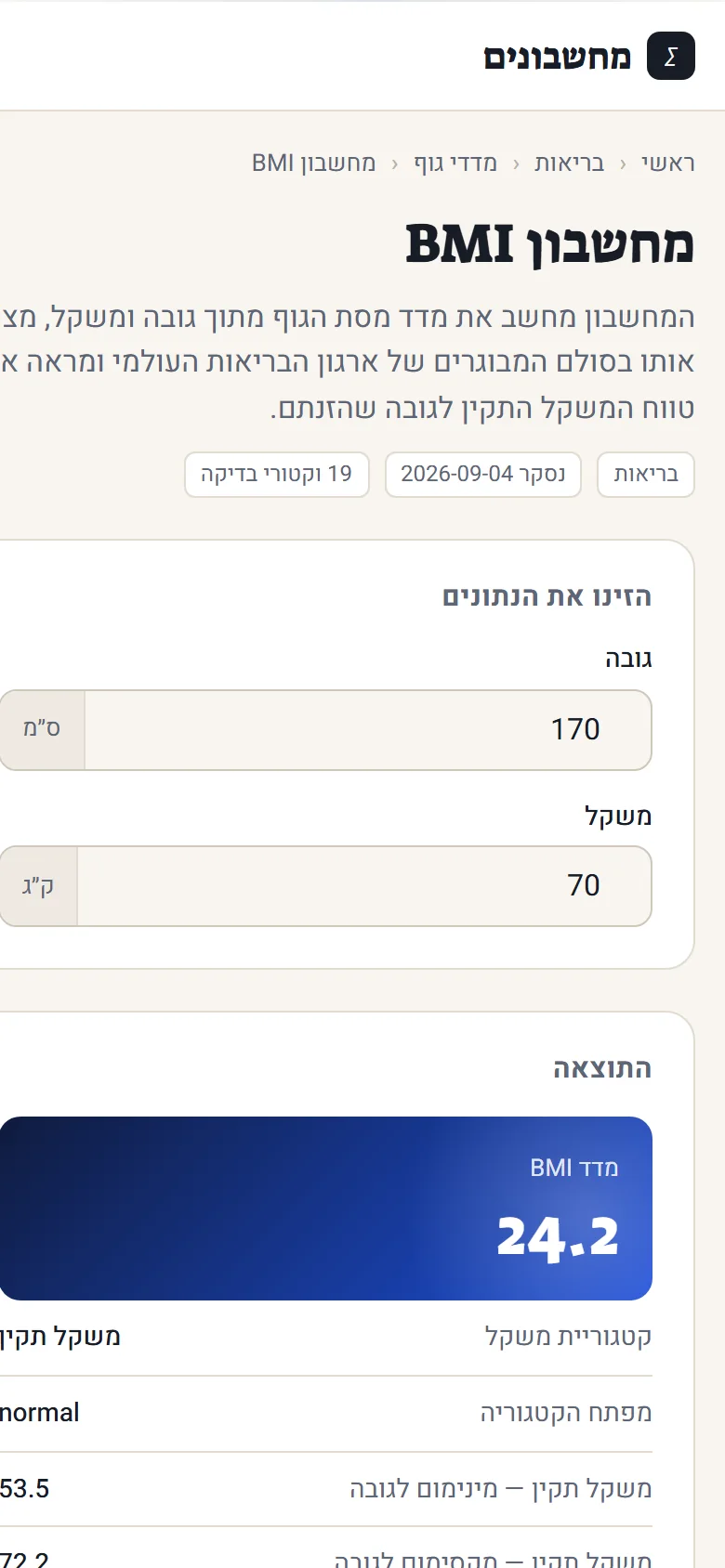
A pure module for every calculator
Each calculator is a TypeScript module that takes input and returns a result, with no network calls and no clock or randomness of its own. So any page can be reproduced exactly as it stood on its build date.
A Hebrew specification for every calculator
A spec with pseudocode, from which the module and its calculation tests are written.
3,007 calculation tests
Test vectors, meaning an input and its expected result, worked out from the specs. Every module passes them, along with the core tests.
918 documented assumptions
Every constant comes with a value, a unit, an effective date and a source. A shared rate, like the tax brackets, lives in one place only, and every calculator reads it from there.
Input checks before the formula
Every input is validated with fixed error messages, and the formula only ever receives valid input.
Links and questions
Each calculator links to two to six related pages, every page has a cap of 12 incoming links, and no page is orphaned. The corpus holds 732 FAQs in all.
Risk register
A list of every value that hasn't been verified and every value that goes out of date by itself, what happens if it's wrong, how to check it and who decides.
Banner kit
A banner for the whole site and one for each of the nine categories, each in five formats for social networks and link previews.
For example, the finance domain banners, 38 calculators, as a link preview and as a story: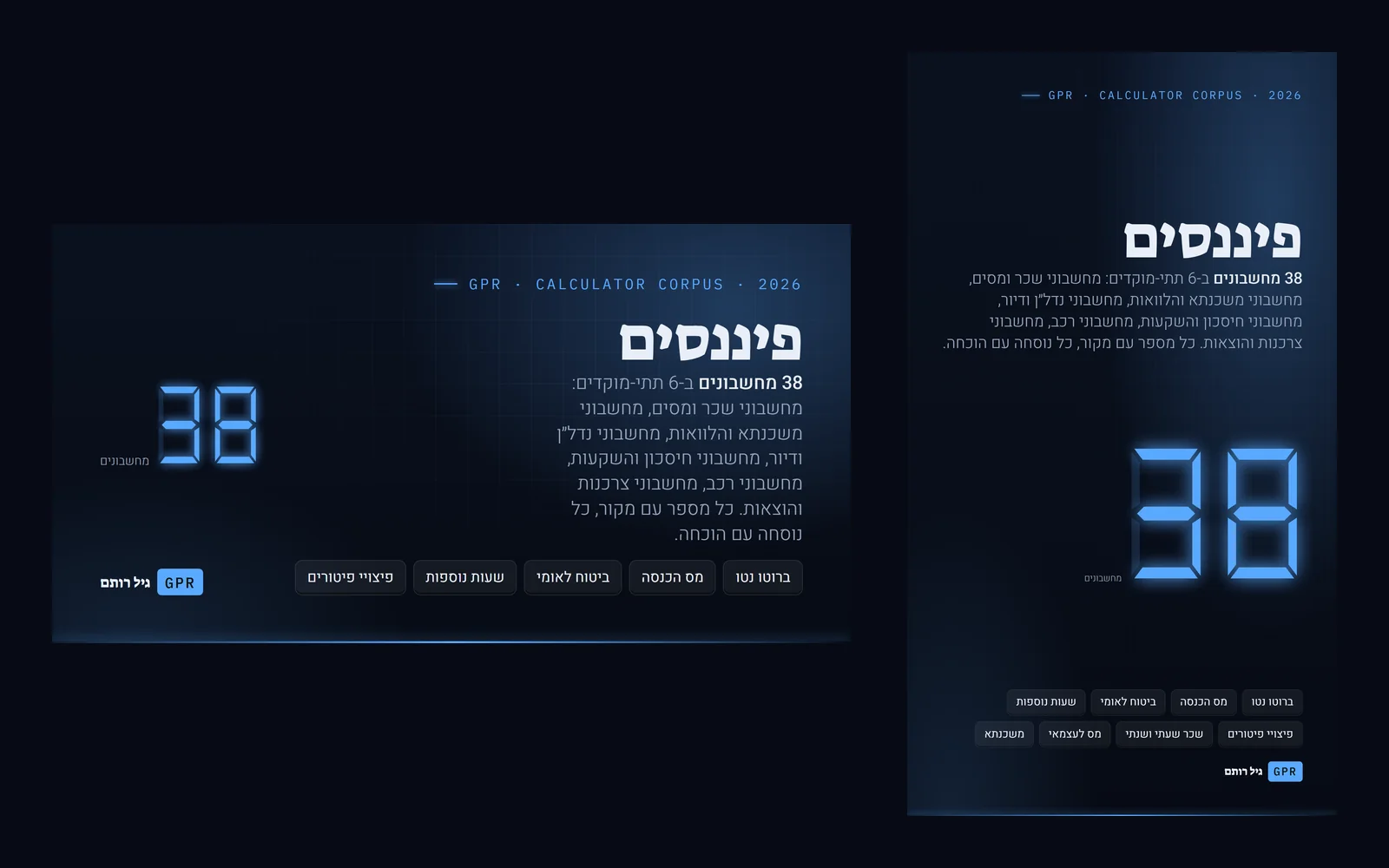

Why the numbers can be trusted
Every number on a page can be traced to its source and to the date it's correct for. When next year's tax brackets change, one value is updated, and every calculator that uses it updates with it.
Along the way I added four calculators the reference site doesn't have: mortgage refinancing, keren hishtalmut (an Israeli tax-advantaged savings fund), import tax on a personal car, and intermittent fasting. And the gross-to-net calculator also works backwards, from net to gross, because that's the question people ask when they negotiate a salary.
The tests prove consistency: every module matches its spec, and every spec matches the site map. They don't prove that a constant is correct, because a wrong number copied faithfully passes everything. That's what the risk register is for, and the clinical constants, such as the World Health Organization growth charts and children's dosages, were checked against outside sources.

What happens behind each page
The corpus itself is data and functions. Each page is built from the page model: the input fields, the results, the assumptions with their sources, the FAQs and the links. The original engine is also packaged to run in the browser.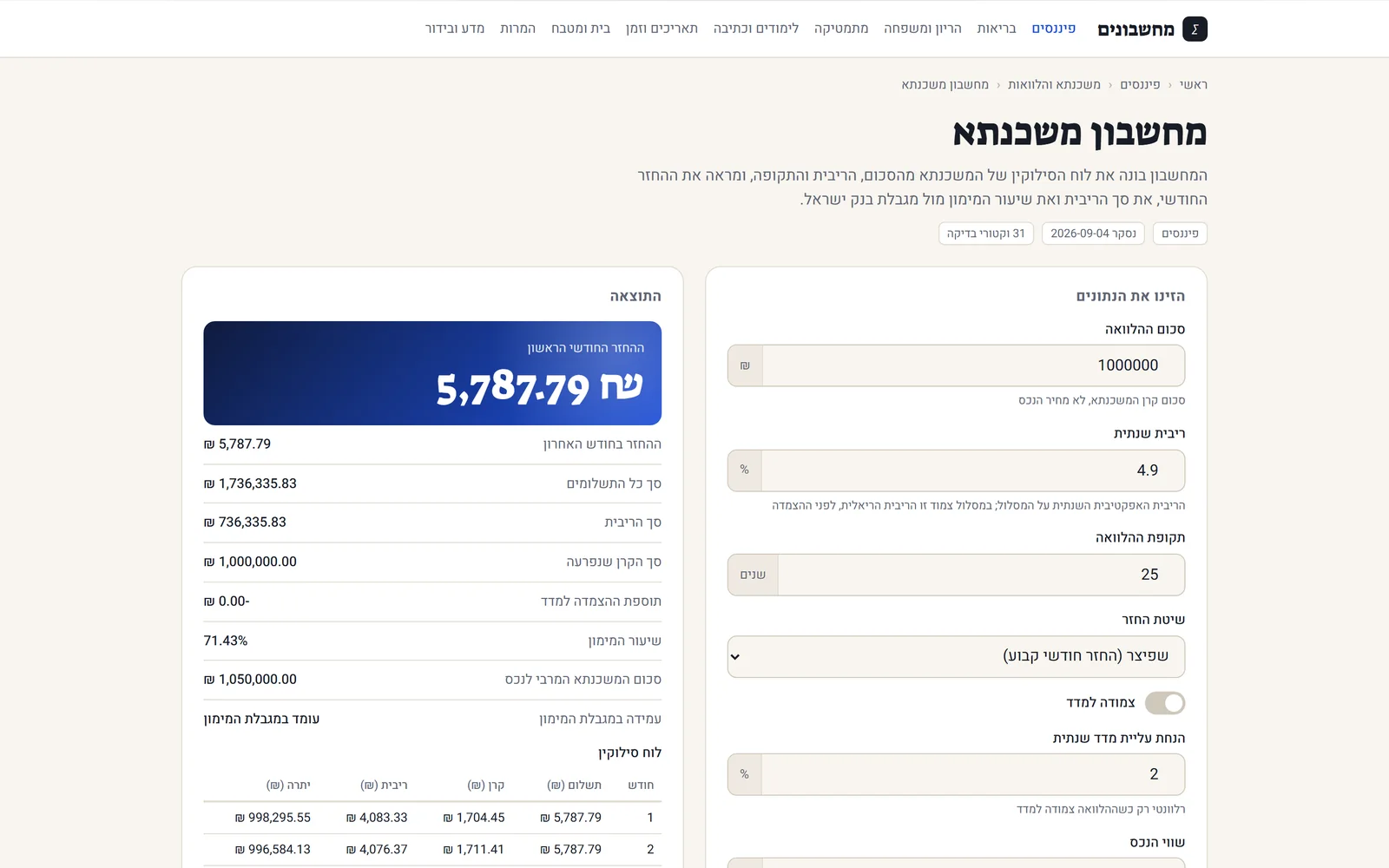
Every change goes through four automated checks, from the site map to the link graph, and 4,113 tests, all passing. What's left before going live is the site layer that will sit on top of the corpus, a name and a domain, and updating the dated prices before launch.


Need a calculation tool where you can trust every number?
If that sounds like your problem, talk to me.