
Dues · Votes · Signing from your phone · In Hebrew
ZUZY4-VAAD-BIT:a system for the building committee, from collecting dues to signing documents
What a building committee looks like without a system
In Israel an apartment building is run by a house committee of its own residents, the vaad bayit. It manages other people's money, and usually does it on WhatsApp and in Excel. Who paid, who didn't, how much is left in the fund and why a supplier was paid. Every question like that ends with scrolling back through a group chat.
Then a decision comes along that needs a vote, or a document that needs the residents' signatures. Whoever doesn't reply gets chased. When someone does sign, there's no proper record of it. And most residents open everything on their phone, not in an inbox.
What I built
ZUZY4-VAAD-BIT is a product of ZUZY, the company I founded with Dan Halperin to build AI and cloud solutions, and I designed and built it. It is three apps on one core: an app for the committee, an app for residents and a payment page. All three are fully in Hebrew, right to left.
The committee app
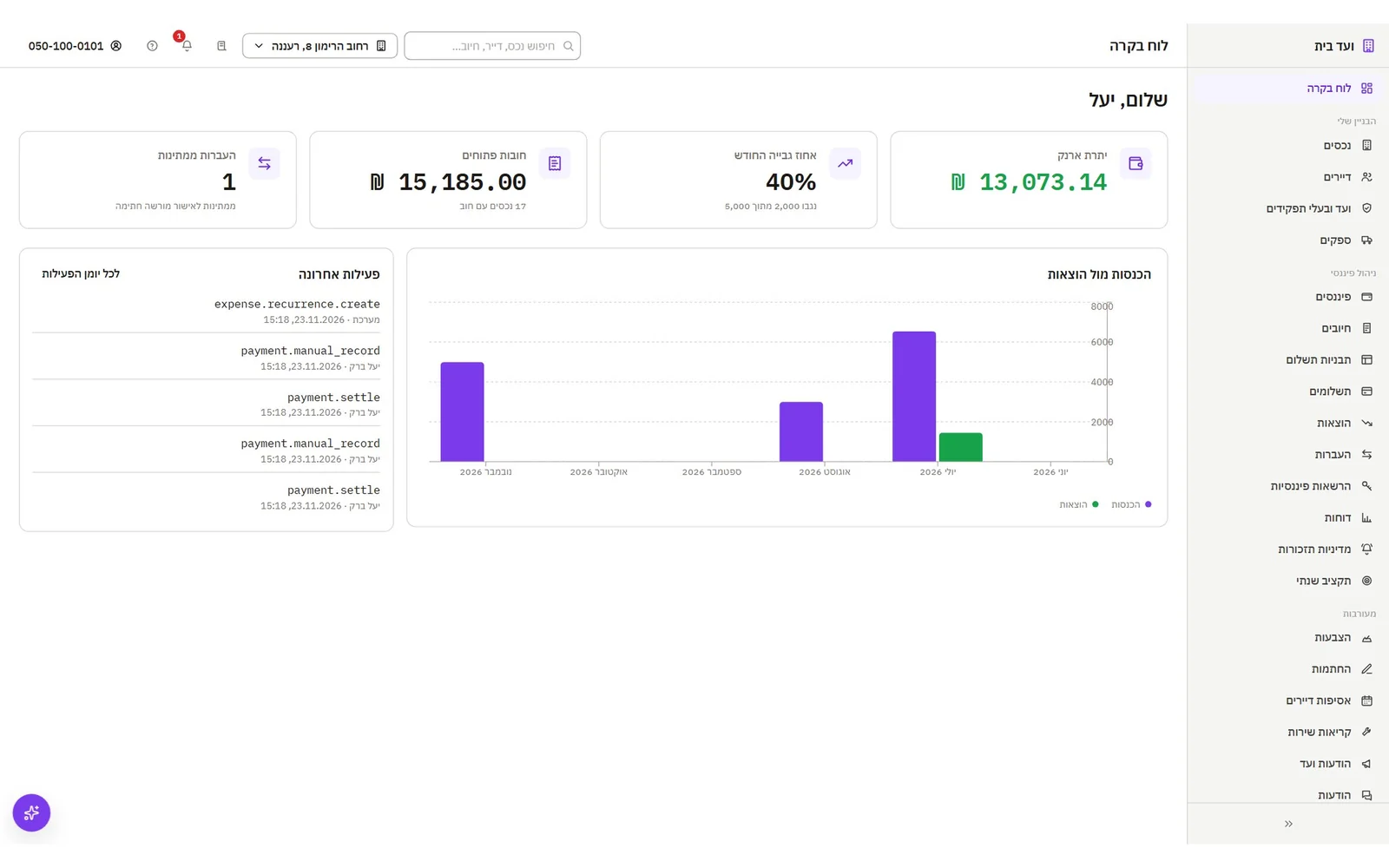
A dashboard with the fund balance, this month's collection rate, open debts, and income against expenses. From there the committee manages charges, payments, expenses, properties and residents.

Charges and reminders
The monthly committee fees are created automatically, and running the same month again doesn't create a double charge. Anyone behind on payments gets reminders in four steps, and a payment that comes in just before a reminder stops it.
Transfers with two signatories
A payment to a supplier goes out only after a second authorized signatory approves it, someone other than the person who asked for the transfer.
Votes and signatures
The resident gets a link, logs in with a one-time code sent to them instead of a password, and votes or signs from their phone. At the end there's a PDF in Hebrew: the signed document, the vote summary or a receipt.
Service calls
Every fault in the building is logged with a category, where in the building it is and how urgent it is, and the system flags any call that has gone past its response time.
The resident app
On their phone, residents see how much they owe, which charges are open and what the committee has announced. It was built for the phone first.
A ledger that can't be rewritten
Money is stored in whole agorot, the Israeli cent, with no fractions and no rounding, in a double-entry ledger that is only ever added to. A transaction can't be edited or deleted, and the database itself keeps the books in balance.
Activity log
Every financial action is recorded with who, what and when, in the same operation, not afterwards.

What the committee and the residents get
The committee no longer asks "Who still hasn't paid?" or "Who still hasn't signed?". It sees the answer on screen, and the reminders go out without anyone having to chase.
Residents get a clear answer on their phone: how much they owe, for what, and what was decided. And when someone in the building asks where the money went, there's a recorded transaction with a date and the name of whoever approved it.

How it runs day to day
The committee works from one app, and the residents from their phones. In the background, 17 scheduled jobs run: creating the charges, the reminder steps, the notices and the recurring expenses.
The core is made of 17 independent packages, one for each area: charges, payments, expenses, transfers, votes, service calls and the rest. The system runs on its own server, and every change goes through automated tests before it goes live.


Got a process that stalls because you can't chase everyone?
If that sounds like your problem, talk to me.