
Research · Content · Pages · Rankings
ZUZY4SEO:a command center for SEO and content, built in Hebrew from the ground up
Why one more SEO tool isn't enough
Anyone running SEO today works with a pile of tools. One measures positions, another shows performance, a third writes content. Each sees one piece, and a person joins them up, in a spreadsheet.
And the joins are exactly where SEO breaks. A new article cannibalizes an existing page. Content gets written without knowing which phrase it's meant to work for. And most tools were built in English, so Hebrew gets a flipped interface as an afterthought.
What ZUZY4SEO does
I designed and built ZUZY4SEO at ZUZY, the AI and cloud development company I founded with Dan Halperin. It does the SEO work itself, in one loop: in-depth analysis, strategy, writing, internal links and measurement.
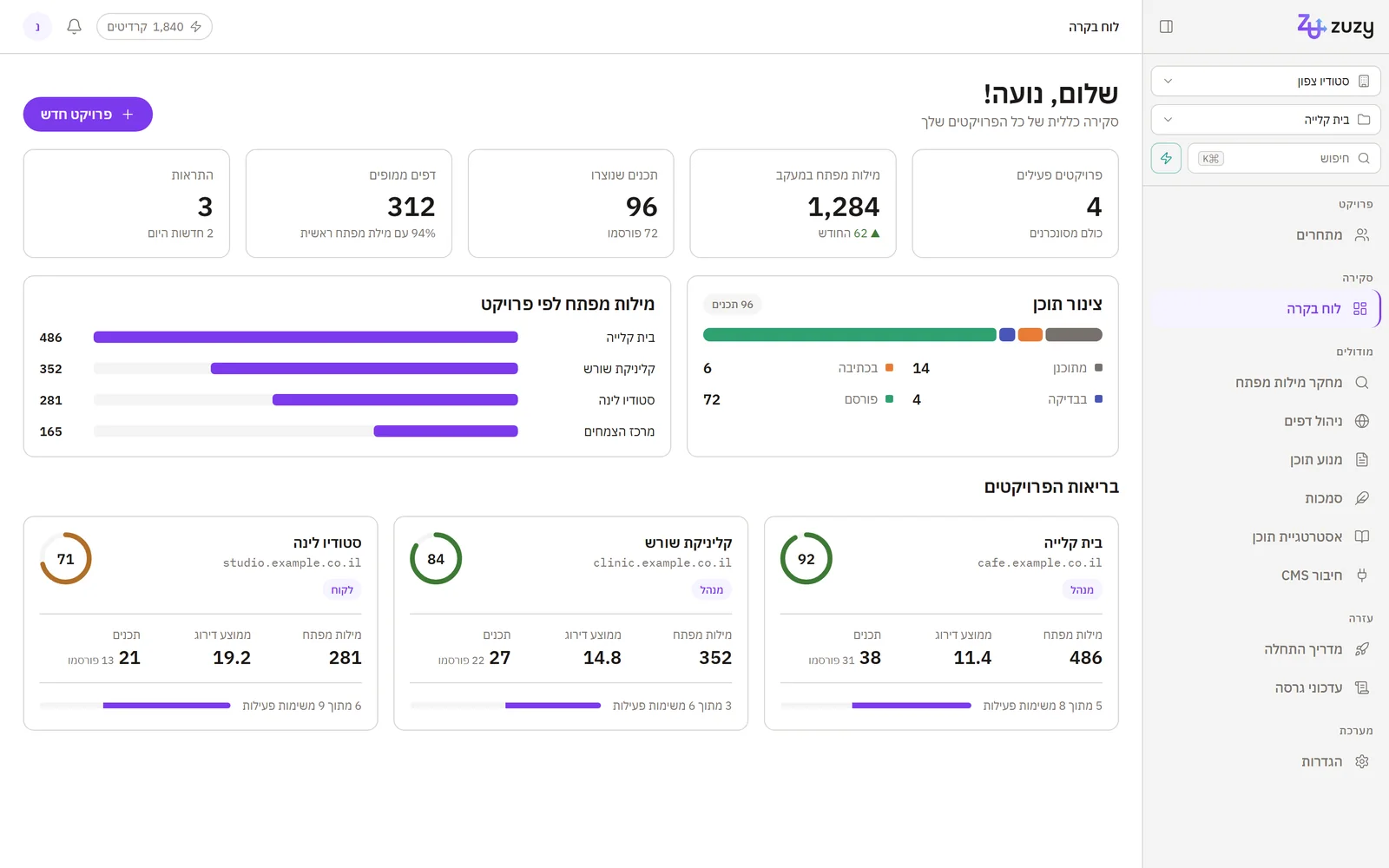
Dashboard
One view of every project: tracked keywords, content created, mapped pages, alerts, and a health score for each project.
Keyword and competitor research
In-depth analysis of the phrases and the competitors in the field, which decides what gets written and on which subjects.
Page management
Every page on the site is mapped to the phrase it targets, and the system detects cannibalization, when several pages compete for the same phrase.
Content strategy
A content board with tasks moving from planned to writing, review and published, suggestions raised by the AI, and a map of content gaps. The board mixes new content with optimizing what's already there.
A two-agent content engine
The first agent writes in the brand's voice, following its audience and its guidelines. The second shapes the text for search: headings, internal links and metadata. The brand's identity isn't flattened for the sake of SEO.
Writing styles
Personal, marketing, and SEO-based articles for the site, each in the client's voice.
Image engine
Images for the content, created in the client's visual identity.
Content editor and scoring
An editor where every article gets a score for SEO, readability and brand voice, with a preview of how it will look in search results.
Internal links engine
Optimizes the links between pages so that authority flows to the right pages.
Rank tracking
Positions for every phrase, the spread across the top 3, top 10 and top 100, a visibility score and history over time.
Site connection and integrations
A finished article is pushed straight to WordPress, and the system is connected to the measurement tools and the competitor data, all in one place.

What it changes for whoever runs a site's SEO
Research, content, pages and rankings no longer sit in separate tools. Keywords feed the content, the content creates pages, the pages feed the rankings, and the rankings sharpen the next strategy.
And the Hebrew isn't a translation. The interface was built right to left from the first component, and the content is written in the brand's own Hebrew, not machine Hebrew.
By the way, I built this content engine to the level of the system I built for Helga Rekanati, with more creation tools on top of it. The difference is that with Helga, most of the work went into training her voice, not into the interface and the settings.

How you work with it
You open a project for a site, and ZUZY4SEO maps its pages and phrases. From there the content board suggests what to write and what to improve, the agents write and shape the text, and I or whoever manages the project go over the article in the editor before it's pushed to the site. Rankings are measured over time and feed back into the strategy.
Under the interface there are nine modules and about 72 data tables, on Next.js, Supabase and Claude.

Running SEO and content across five tools that don't talk to each other?
If that sounds like your problem, talk to me.